In January, a 24-year old nutrition influencer named Jacob Smith made the grave mistake of becoming a little too curious about tofu.
Smith had read a study about the health benefits of eating less meat and figured he’d try to replace a small amount of the animal products he ate with plant-based foods. So, as content creators do, Smith brought his 170,000 Instagram followers along on his plant-based exploration.
In his first plant-based video, he filmed himself cooking tofu. In the comments, some of his followers gave him helpful tips on how to make it better next time. But a lot of people called him the well-worn insult known to any guy with a platform who dares to proudly eat tofu on social media: soy boy.
- In order to sustainably feed a growing world population, people in rich countries will need to eat less meat and more plant-based foods. But that’s proven to be a tough sell to men, many of whom believe that eating meat is part of what makes them masculine.
- The idea that real men must eat meat is pervasive in food advertising and pop culture, and its roots can be found in the “man the hunter” theory of anthropology, which argues that prior to modern civilization, men handled the hunting. The theory has come under increasing criticism, as researchers have found more evidence that throughout human history women hunted too.
- At the same time, a growing movement of professional and amateur male athletes have embraced plant-based eating, arguing it helps them competitively — and doesn’t make them any less manly.
Cooking tofu was a departure for Smith, as just a few years prior, he had virtually no interest in plant-based proteins. Early on in college, Smith had followed what amounted to a carnivore diet — eating loads of meat and eggs — and dabbled in other dietary trends. But he eventually went back to a more “normal diet,” he told me, and went on to earn a master’s degree in dietetics. During his graduate program, he built a large Instagram following by explaining what he describes as “evidence-based nutrition,” covering research and debunking inaccurate health information.
Although Smith has remained a meat-eater, the response to his tofu video inspired him to start a series of videos testing out other plant-based protein sources, like seitan and tempeh, cheekily leaning into the criticisms he was getting. “I started calling it the Soy Boy Chronicles,” Smith told me.
The chronicles caught fire, each video racking up hundreds of thousands of views and with them, a flood of angry comments.
For “almost the majority of haters,” he told me, “their main critique about eating plant-based is it’s going to make you have more estrogen and that’s going to make you more feminine.” Of course, men and women both naturally produce the hormone estrogen, and eating soy foods doesn’t change men’s hormonal makeup. Plus, it’s well-established that soy products are not only safe to eat but also confer a number of health benefits, especially when replacing processed and red meats. (And estrogen, it turns out, may have been critical to early humans’ hunting abilities — more on this later.)

Some commenters said his newfound interest in plant-based foods explained why he’s weak (he is, in fact, quite jacked), made his voice sound “feminine” (he sounds like your average dude), or even more absurdly, that it would lead him to grow breasts or become gay. “I don’t even know where these ideas come from,” he told me, exasperated.
But Elina Vrijsen, who researches food and communication sciences at the University of Antwerp, in Belgium, has some ideas about that. “People probably perceive him as a very normative masculine man because he eats meat” and he’s fit, she told me. “But then he breaks his boundaries of masculinity by eating vegan food, and for a lot of people, this brings a lot of tension and a lot of questions.”
Smith has a similar theory. If he became fully vegan, he suggests, the criticism might have been more tame. But “people have more desire to defend themselves against people who somewhat eat like them,” he said. He’s showing a middle ground is possible — that one doesn’t need to be vegan, nor endorse carnivorism.
One day, just a couple weeks after he had launched the Soy Boy Chronicles, he tried to log on to Instagram only to find that his account had been taken down. The reason? According to a screenshot Smith shared with Vox, Meta said it doesn’t allow its users to follow, praise, or support people or organizations it defines as dangerous.
Smith was confused. He never cursed in his videos or even talked much about politics, save for occasional nutrition news, and said he certainly hadn’t promoted violence, criminal activity, or terrorism (which would have violated Meta’s terms if he had). He described it as a “family-friendly account.”
Meta told me the company reviewed his account and stands by the ban. “We reviewed and determined the correct enforcement action was taken for violating our policies,” a spokesperson told me over email. The company declined to answer specific questions about Smith’s account and how he had violated its policies.
Smith has continued his Soy Boy Chronicles on TikTok, but he says commenters there are even nastier than on Instagram.
Putting aside the Instagram suspension and whatever caused it, the backlash Smith garnered for eating tofu is just one of the latest examples of what can happen when men, especially those who appear traditionally “masculine,” promote plant-based eating. And Smith probably won’t be the last, so long as legions of people believe that masculinity requires heavy meat consumption and perceive men who question that belief to somehow be a threat to the status quo.
From the mid-2010s to the early 2020s in the United States, there was a brief window of time in which plant-based eating was gaining more popular traction and many more people were questioning conventional gender norms. But numerous trends suggest those cultural currents have changed direction in recent years. American culture has become increasingly fixated on protein, especially from animal-based foods; Health and Human Services Secretary Robert F. Kennedy Jr. promotes a carnivore diet; and then there has been the further rise of the so-called manosphere, a loose network of male influencers promoting an intensified vision of masculinity that often entails high levels of meat intake.
But the belief that “real men eat meat” long preceded the latest nutritional and cultural trends, and it is so deeply ingrained that a small but rich academic field has sprung up to study it.
It’s much more than a niche intellectual pursuit, though.
Figuring out how to reduce the consumption of animal products in wealthy countries is a pressing issue, as meat and dairy production account for up to one-fifth of global greenhouse gas emissions and are the leading drivers of global deforestation and US water pollution. Global meat production also represents a moral atrocity, with hundreds of billions of animals reared in grueling factory farms.
Women in Western cultures have generally proven to be more open-minded to reducing their meat intake. But to bring about wide-scale change in our food system, nonprofits, academics, policymakers, food businesses, content creators, and others will have to figure out how to persuade the other half of the population that what they eat doesn’t make them more or less of a man.
The myth of man the hunter
The idea that “real men eat meat” is a pervasive belief across Western cultures, and research in the US, Europe, and Australia bears this out. Studies from these places have found that:
- Men eat more meat than women and report enjoying meat more than women.
- Men who more strongly conform to masculine norms report eating more meat and show less willingness to reduce meat consumption (men who identify as more masculine are also more resistant to considering vegetarianism).
- Men are more likely than women to perceive meat as masculine, while both men and women are more likely to associate meat with masculinity and vegetables with femininity.
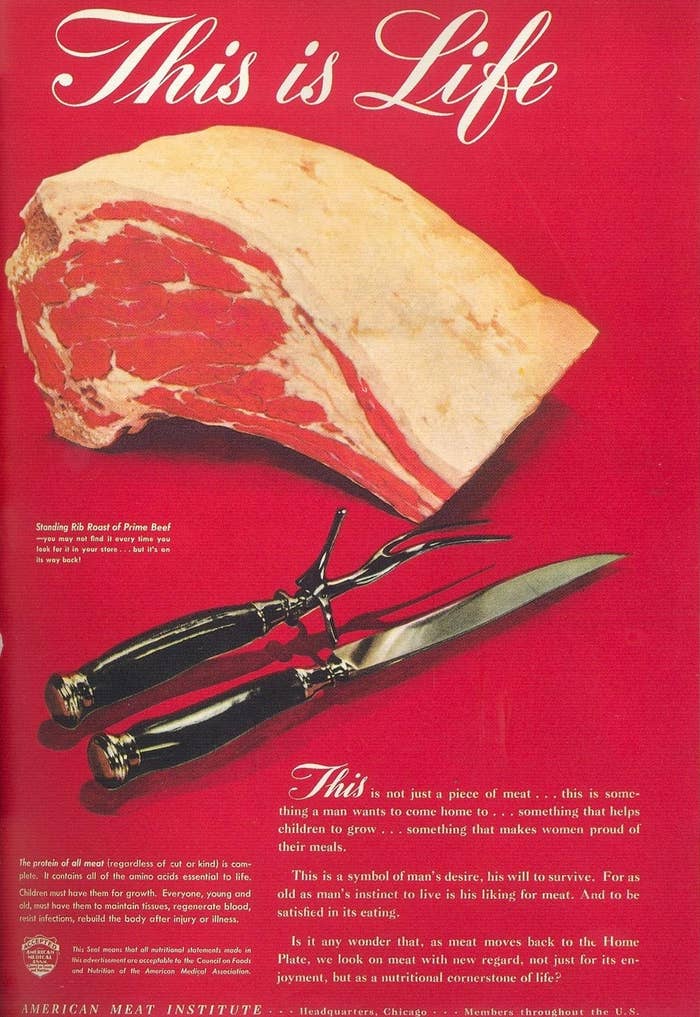
When I asked several researchers how this belief came to be so prominent, all of them pointed first to food advertising, which began to be segregated by sex in the 1950s.
That’s given us TV ads like Burger King’s 2006 “Manthem” commercial, in which a guy served what appears to be a plate of vegetables in a fancy restaurant stands up and marches out while breaking into song, declaring he’s “too hungry to settle for ‘chick food.’” He heads straight to a Burger King as other men join him in song, pledging to “wave tofu bye-bye.” Burgers in hand, they march onto the highway and together, throw a minivan off an overpass, a show of the strength that meat gives them.
The commercial ends with a blunt message: “The Texas Double Whopper: Eat like a man, man.”
WeightWatchers (For Men), Hummer, Slim Jim, and the American Meat Institute have similarly over-the-top ads, while Manwich, Campbell’s Soup, KFC, and others have sent the signal perhaps slightly more subtly. The underlying message can be found beyond the realm of advertising and throughout pop culture, too.
Even plant-based protein companies sometimes use this tactic, advertising with a “masculinized aesthetic,” Vrijsen pointed out. The companies are, according to Vrijsen, seeking to “reassure consumers that reducing meat does not mean giving up your masculine identity…even when the product changes, the general logic often stays in place.”
The answer as to why such marketing has proven so effective can be found in the field of anthropology, which for decades has posited that throughout the long trajectory of human history, a clear division of labor separated the sexes: The men went off to hunt while the women stayed behind to safely gather edible plants and raise children, a vision put forth in then-popular theories, such as in the influential 1968 book Man the Hunter.
But some scholars have been poking holes in this widely accepted theory. Two of the most prominent critics of the “man the hunter” theory today are Sarah Lacy, an assistant professor of anthropology at the University of Delaware, and Cara Ocobock, an associate professor of human biology at the University of Notre Dame, who’ve published papers together on the issue.
Most hunting didn’t look like “a super strong man by himself” engaged in a “battle of will against a wooly mammoth,” Lacy told me. Rather, much of it was probably mixed-sex groups who chased animals off cliffs, ambushed them from bushes and trees, caught them in nets, and injured them with weapons, which made it easier to chase them down to the point of exhaustion.
While this work required strength, it also required endurance. And women, Lacy and Ocobock argue in a 2023 paper published in the journal American Anthropologist, are particularly well-suited for the endurance needed to effectively hunt, thanks in part to higher estrogen levels.
“During exercise, estrogen seems to encourage the body to use stored fat for energy before stored carbohydrates,” the two wrote in a piece for Scientific American. “Fat contains more calories per gram than carbohydrates do, so it burns more slowly, which can delay fatigue during endurance activity.”
There’s “this emphasis that testosterone is the only hormone that gives people an [athletic] advantage,” Lacy told me, but “estrogen absolutely conveys sports advantages,” too.
Some archaeological evidence also conflicts with the dominant “man the hunter” theory, Lacy said. This includes prehistoric women buried with hunting equipment and Neanderthal remains that suggest men and women were potentially facing off with animals at a similar rate.

Much of the “man the hunter” theory, Lacy said, also rests on research into a small number of well-studied hunter-gatherer, or forager, societies, which only tells us so much. These handful of groups represent “such a tiny snapshot of the amount of variation that would’ve been present throughout multiple millions of years of human evolution.” At the same time, more recent historical ethnographic and archaeological research, along with research into Indigenous groups, provide plenty of evidence of women hunting.
This kind of research “challenges the assumption that the link between masculinity and meat consumption has a clear historical foundation,” Vrijsen, the food and communications researcher, told me. “And instead, it suggests that this association is more cultural than biological — and shaped sometimes by ideology rather than evidence.”
Lacy and Ocobock felt this observation firsthand in the wake of their published research. While it was well received among their anthropology peers, Lacy told me, some people on the internet were incensed.
The overwhelmingly negative public response came from “predominantly men who were just so offended by the insinuation that hunting is not the special thing” that they did that drove human evolution, Lacy told me. “It was really wild.” After Lacy and Ocobock had published their piece on the topic in Scientific American, the magazine offered them counseling “because the reaction — specifically on Twitter — was so virulent,” Lacy said.
Masculinity, with less meat
Rob Velzeboer’s first glimpse into the dicey gender politics of meat came to him when he briefly competed as a boxer in the mid-2010s. He decided to go vegetarian out of a sense of duty to help animals, and while his peers weren’t necessarily hostile to the change — these were real-life acquaintances and friends, not internet strangers — they were often “very, very suspicious,” he told me.
Velezeboer is now a researcher at the University of British Columbia, where he studies meat and masculinity, among other topics. Lately, though, he’s become less interested in why this issue is so charged and more interested in figuring out how to have more productive conversations with men about it.
He’s currently working on a meta-analysis review of numerous studies to look at how men and women react to different messages on the issue. So far, by looking through dozens of studies, he told me that women are more open to messages about harms inflicted on animals in meat production, while men are more receptive to messages about the health benefits of plant-based eating.
Meanwhile, other research by Velzeboer has found that some vegetarian and vegan men frame their lifestyle through traditional American masculine norms, like: independent thought, rationality, discipline, health, alignment between their values and behavior, or even as a rebellious act that demonstrates they don’t just go along with the crowd.
Some of those traits apply to David Meyer, an 11-time Brazilian jiu-jitsu world champion and host of the Ageless Warrior Lab podcast.
“I’m suspicious of when culture tells us we should be this way or that way,” Meyer told me. “[Food] companies are trying to make something appeal to us in a certain way, and we need to think for ourselves.”
Meyer told me that he thinks meat can certainly be part of a healthy diet, but for him, he felt that eliminating animal products from his diet decades ago improved his own health and athletic performance. He’s also an animal lover, and said he doesn’t want to support animal cruelty if he doesn’t have to.

“It works for me, and I’m not saying it would work for anybody else, but a lot of the fighters that I work with have reduced animal products and even dairy specifically, and they feel much better,” Meyer said. But if for some men, eating meat is part of their view of themselves as being masculine, that’s fine by him.
There are plenty of other professional male athletes that have embraced a plant-based diet, too, like NBA players Kyrie Irving and Chris Paul, strongman Patrik Baboumian, tennis star Novak Djokovic, and UFC champion James Wilks, featured in The Game Changers, a documentary about elite athletes who happen to eat plant-based.
Dominick Thompson, a content creator and longtime vegan with very big muscles, views his veganism, in some ways, as an extension of his traditional masculine side.

“No matter your diet, masculinity is about protecting — being a natural protector of the most weak and the most vulnerable,” Thompson told me. “And that includes not only animals, but human animals — those that simply can’t protect themselves. To me, that’s a pillar of what masculinity really is.”
After thinking about it long and hard enough, it all can get a bit muddling. Masculinity, femininity — these are squishy, evolving terms that mean different things to different people at different times, and are hard to pin down. Vrijsen, who’s conducted focus groups with young men about masculinity, told me they themselves often have a hard time defining what it means to them.
That uncertainty might explain some of the rise of the manosphere, in which prominent male influencers have stepped into the void to define masculinity for young men — and for some, like Andrew Tate, Jordan Peterson, and Joe Rogan, high-meat diets are part of it.
It’s a big shift from where the plant-based movement was just a decade ago, Thompson said, when people seemed much more open to it. It was also a time when more and more people were questioning conventional gender norms. “But now I do feel like a lot of people are a little bit more close-minded” to eating plant-based, Thompson said. “We have a lot of work cut out for us.”
And Smith, for his part, is still posting through it with his Soy Boy Chronicles, forging ahead in the gray — often viciously patrolled — online territory of what it means to be a man in this country who also eats tofu.